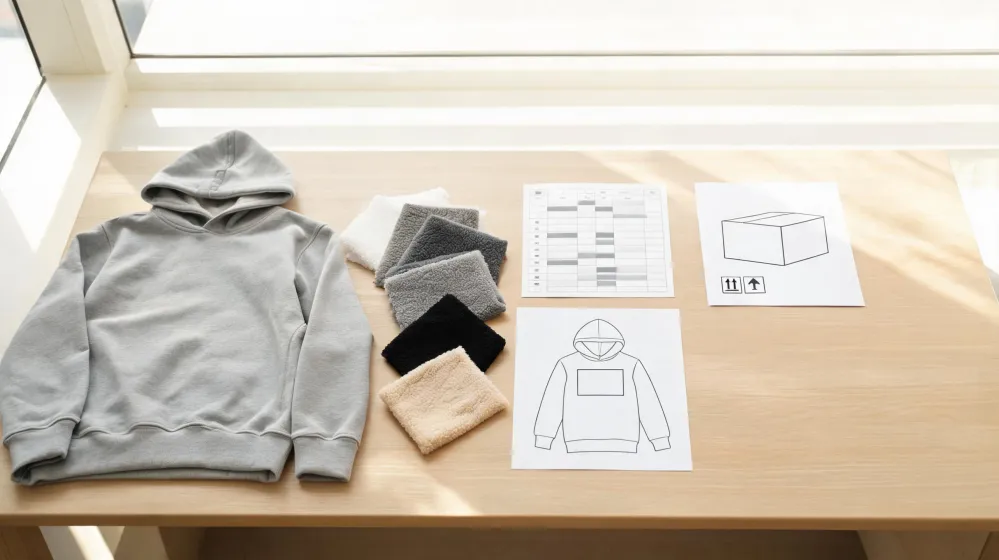
Two buyers approve the same wholesale hoodie sample at the same factory. One reorder comes back with the same cuff ribbing, same hand feel, same stitching trim. The other reorder arrives close enough to pass a quick look, then fails at the cuff and the fabric weight. The sample did not change. The control did. The first buyer kept a versioned record next to the sample; the second kept a signed sample and a photo roll.
An approved sample only proves that one version was accepted once. It does not carry instructions into the next purchase order. Most people assume a signed sample plus a few spec photos is the control file. In fact, the sample is a physical reference, and the record is what controls the second order. That difference is the whole job of wholesale hoodie sample reorder control.
Your approved hoodie sample stops controlling order two
The mistake is treating the sealed approval sample as the rule for future runs. The consequence shows up late: the second order gets negotiated from memory, a few photos, and whoever is on email that week. A cuff ribbing change or a lighter fleece can pass a quick visual check and still miss the approved hand feel. The correct move is to keep the sample as the physical reference and put control into a versioned record.
Printful’s graphics and embroidery guide makes the sequencing point: “Hold off creating large orders with designs you’ve never tested.” That line comes from a custom-product guide and applies to the products and options described there, not to every hoodie factory. Read it as a buying discipline, not a supplier guarantee: test the design and the sample first, then scale.
Most people assume the signature on the sample approval sheet settles the spec. Actually, it settles only that one acceptance event. The record has to say which version was accepted, what changed, and which future order or template the change belongs to.
A change on one order stays on that order
Printful states the boundary plainly: “Any changes you make to an order will apply to that order only.” It adds: “changes you make to orders won’t apply to products on your store.” Those are the words of a custom-product platform describing its own order flow, not a universal rule for every hoodie supplier. The purchasing lesson is still useful: an order-level fix and a catalog-level fix are separate objects.
Order edits do not travel. A fix made on one purchase order disappears from the next one unless someone writes it into the spec or template that the next order uses.
The mistake is assuming that fixing the current purchase order fixes the product you plan to reorder. The consequence is a clean-looking order and a stale store listing or internal spec sheet. The correct practice is to log two lines for every change: one for the order, one for the template or catalog. If only the order line exists, the next buyer inherits the old version.
Approving a sample with chat logs and photos
Chat approval feels fast because it is fast. It is also the weakest form of sample approval. The error is using a message thread as the approval system. The consequence appears at the third order, when nobody can tell which change was approved, which was a one-time favor, and which was only discussed. A message stream has no version number, no owner, and no scope.
Use one record per hoodie style. Each change line should carry the date, the person who approved it, the reason, and the scope: order only or template. That matches the boundary in the Printful wording above, where order changes do not automatically become product changes. A hypothetical example: suppose the cuff ribbing is swapped in a private message and never written down. The next reorder uses the old ribbing because the factory never received a controlled change. That is not a factory failure; it is a record failure.
What the record must show before you reorder
Before you release a reorder, the record should answer a buyer’s questions without a phone call. A practical field set: style name and version, sample approval date and approver, change lines marked order-only or template, a pointer to the current spec sheet, and the purchase order the approved sample belongs to. This is a buying control list, not an industry standard.
The mistake is keeping only photos. A photo can show a cuff, but it cannot show whether that cuff was approved for one order or for the catalog. The consequence is a record that looks complete and still cannot answer “what changed?” The correct practice is to attach photos to a version, not use photos as the version.
Also record what you do not have. This review did not receive supplier quotes, MOQ commitments, capacity audit results, lead-time promises, or certification reports for a candidate factory. Those belong in an inquiry checklist, not in the record as confirmed facts. A record that mixes open questions with approved specs is worse than a short record with clear gaps.
When this record stops being worth the trouble
The conclusion flips under a few conditions. If you are running a one-time test drop with no reorder intent, a heavy sample record adds work without controlling anything. If the supplier already locks every purchase order with a written change notice, your separate record may duplicate their system. And if the record lives with one person, it fails when that person leaves. The mistake is keeping the record alive after it stops controlling a decision; the consequence is paperwork that looks rigorous and slows every order. The correct move is to retire it or narrow it to the few fields that still matter.
Boundaries matter too. This record is not a factory audit. It cannot replace missing quotes, MOQ evidence, capacity review, lead-time commitments, or certification reports. No physical sample test or third-party test was performed for this article, so the record cannot be used to guarantee durability, performance, UV protection, antimicrobial claims, injury prevention, or environmental benefits. Treat it as a control document, not a performance certificate.
Who should skip the sample record entirely
This is not for the buyer who runs one test order and never reorders, or the buyer who pulls blank stock hoodies off a shelf and never discusses a spec. Building a versioned record there is overhead with no payoff. It is for the team that plans to push an approved wholesale hoodie sample into repeated bulk orders and wants the supplier to accept written change control.
The mistake to avoid at the end is building the record after the first bulk order. By then the second order is already running on memory. The better tradeoff is to spend the change-control time up front, while the sample is still fresh, and keep the record with the purchase order. If the supplier refuses written change control, a record will not fix that relationship. If the supplier accepts it, the record is what makes the next reorder boring in the best way.
