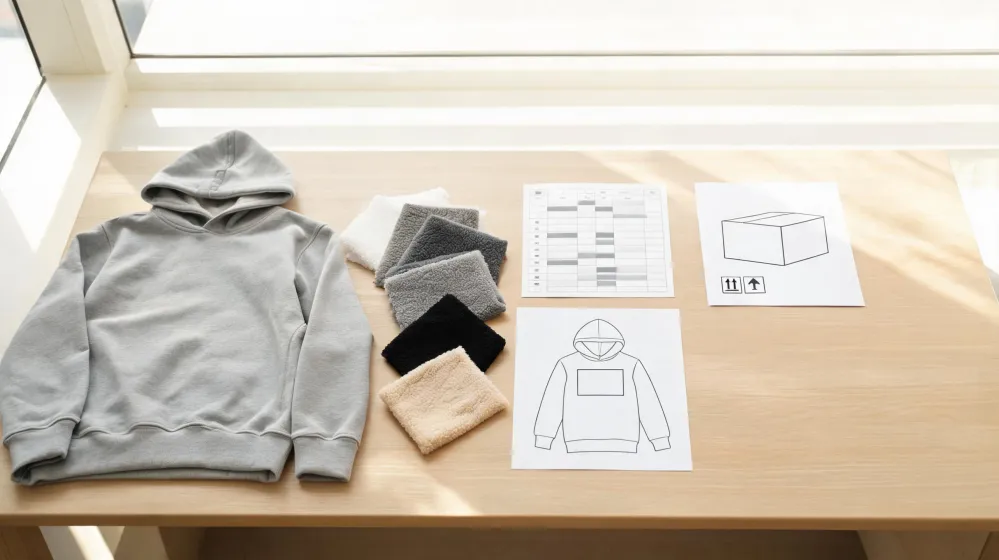
Does the embroidery file get approved before bulk, or does the first production run become the approval? It gets approved earlier, on a digitized preview rather than the mockup, and that difference decides what your team is actually signing.
For a wholesale embroidered hoodie order, the preview is the record worth putting your name on. It is rendered from the machine file rather than from a design idea, which is what makes it checkable. Sign the mockup instead and the rework is locked in before the first bulk unit is sewn.
What an embroidered hoodie digitization check actually approves
What object is actually being approved when a sourcing team runs a digitization check on an embroidered hoodie? Not a garment, and not the picture your designer forwarded. The object under review is a stitch file — the machine instructions — rendered as a preview so a human being can look at it and say yes or no.
The embroidery guide published by Printful is blunt about the hierarchy: the digitization preview will always be more accurate than the mockup. The reason matters more than the claim. The preview uses a digitized file and shows the direction of the stitches.
Stitch direction is a manufacturing variable. It affects how a satin column wraps a curve, where a fill starts and stops, and whether a small letter stays legible under a needle. A mockup carries no such variable; it renders a shape and leaves the mechanics to whoever runs the machine.
So the sign-off is a data file plus its rendering, not a picture sitting in an email thread. A file has a version; a picture in a thread has none. That single difference is what makes one approval auditable and the other a matter of memory.
Why the digitization preview beats the mockup
How does the preview differ from the mockup and from the sewn sample, and why does that ordering matter? Three artifacts, three jobs. The mockup is a visual approximation, built backwards from an idea of the finished hoodie. The digitization preview is a rendering of the stitch file itself, which is exactly why it can show stitch direction. The sewn sample is the physical output, and it is the only one of the three that can be worn, washed and measured.
The preview and the sample are not ranked against each other in that guide, because they answer different questions: the preview states what the machine was told to do, the sample shows what the machine did with the thread in front of it.
Why care about the distinction? Because a decision that depends on stitch direction cannot be settled on the mockup alone. Put a small counter inside your lettering, or a curve that has to read cleanly at arm's length, and the mockup will look flawless while telling you nothing about either.
One limit has to stay attached. The guide cited here belongs to a single print-on-demand provider describing its own graphics and embroidery service. It defines what the artifact is and how the two renderings rank against each other. It says nothing about any candidate supplier's machines, threads, capacity or pricing, and nothing in it should be read as a capability claim for the factory you are about to brief.
Why the sewn hoodie still drifts from the preview
If the preview is the more accurate document, why can the finished embroidery still differ from it? Because the process keeps moving after the file is fixed. Embroidering tightens the thread, so the result can also slightly differ from the digitization preview.
Treat that as a process effect rather than a file defect. The file does not degrade on the machine; the thread takes tension and the geometry gives a little. Which means your approval record should carry an expected drift instead of promising an identical match.
For whoever carries the rework budget, the drift shows up as time. A logo that pulls a corner or closes a small counter turns into stitch-out time on replacements, a second approval cycle, and a schedule that slides while the artwork goes back into review. Plan for it as a purchasing risk; do not quote it as a defect rate, because no guide hands you one.
Which file version you are actually signing off
What version and confirmation state must the approval record name so a later change stays traceable? Picture a sourcing team two weeks out from a bulk start, with a hypothetical thread where two emails both read "approved — chest logo." Only one of them names a file version and a render date. When the sample lands with a slightly wider outline, the second email cannot be argued with, because nobody can prove which render it referred to.
The record your team signs should name the file version, the render date, the thread colorway the preview was rendered in, the view that showed stitch direction, the approver and the date. None of those fields is decorative.
Then add the field most teams forget: who is authorized to change any of the above. That is where drift between offices starts. A merchandiser adjusts a shade in a reply, a designer re-renders, and the file in production is now a version quality control has never opened. Naming the change authority costs one line and prevents the whole argument.
What a digitization check cannot prove
What does an approved preview leave completely untested? Nearly everything that comes back in a returns report. Durability, colorfastness, shrinkage after washing, the hand of the fabric, how the embroidery sits on heavy fleece — all of it lives outside the render. Capacity, minimum order quantity, lead time and certification are missing too, and none of them exist anywhere in the material behind this article.
Keep the applicability limit attached to every one of those gaps. One provider's guide to its own service is not a specification for the factory quoting your hoodie, and treating it as one is how a purchasing team inherits someone else's assumptions.
Here is where we land, and it is a preference rather than a finding: we would rather delay a first bulk approval than release it on a mockup with no versioned digitized file behind it. A delayed approval costs calendar time; a wrong one costs re-stitch time, a second sign-off and a slipped ship date.
Turning the check into an RFQ clause
How does a sourcing team put the digitization check into an RFQ so a supplier has to answer it in writing? Send questions rather than requests for reassurance, then compare replies across candidates.
Ask for the digitized file and the stitch-direction preview that accompanies it. Ask which file version and render date the quoted price is based on. Ask who approves a change and how a re-confirmation gets recorded. Ask what drift the supplier expects after thread tightening, and how they want it handled if the sample shows it. Ask whether the machines and threads behind the preview are the ones that will run the bulk order.
None of those answers can be faked with a photograph, and the pattern across a shortlist is more useful than any single reply. A supplier who sends a version number and a stitch-direction view has a workflow. A supplier who sends a fresh mockup has a design service.
Which brings up the objection that usually ends the meeting: isn't the sewn sample the only thing that really counts, and doesn't this just slow the order down? The check does not replace the sample. It makes the sample comparable, because you can now measure physical output against a named file instead of against an impression. Hold the approval until the file version and the stitch-direction preview are attached to the purchase order, then judge the sample against that same version. If a supplier cannot produce the file at all, that absence is the answer you went looking for.
